Tampilkan postingan dengan label gold ETF. Tampilkan semua postingan

Selasa, 23 Agustus 2011

Gold and Silver Chart Patterns: an update

There is an old stock market saying: When in doubt, stay out. But in current politically and economically turbulent times, investors appear to have created a new maxim: When in doubt, buy gold (and silver).

Gold Chart Pattern

image

Gold is being bought as if the financial world is going to collapse tomorrow, or latest by next week. What else can explain a vertical $200 surge from 1700 to 1900 in the two weeks since my previous post?

Admittedly, there is sovereign gold buying, and Venezuela created a flutter by planning to repatriate $11 Billion worth of gold held in overseas banks. The sorry state of Eurozone banks is a major concern. But ask yourself: Is the global economy in a worse situation than it was in 2009?

One can debate the state of the global economy till the cows come home. The bottomline is that the parabolic rise in gold’s price over the past couple of months is unsustainable. The chart is looking extremely overbought, with the 14 day SMA (as well as the 30 day and 60 day SMAs – not shown in the chart above) climbing away from the rising 200 day SMA. A sharp correction, if not a crash, is around the corner.

If you are an investor who would rather buy gold (instead of Colgate or ITC shares), use the likely dip to buy gold ETFs. My preference is for the hefty dividends that Colgate and ITC shareholders receive – not to forget the occasional bonus shares.

Silver Chart Pattern

image

After a four month lull, during which silver’s price went through a decent correction, prices have risen sharply to touch the 44 mark. I had recommended that investors use the recent dip to buy, or to wait till the 42 level is crossed convincingly.

If you missed out on the buying opportunities, wait for a likely pullback towards 42 to enter. The 14 day SMA is turning upwards. The 200 day SMA didn’t stop rising right through the four months of price correction. The bull market in silver is alive and well.

Kamis, 11 Agustus 2011

Is this a good time to buy stocks/funds/gold?

Many small investors must be thinking about this question. Anecdotal evidence from the emails and comments I receive suggest as much. The answer is quite simple: It is a good time to buy if you have the money.

Experts will tell you that timing the market is not a sensible approach to investing. It is how much time you spend in the market that counts. That is because most small investors are happy to book small profits, and miss out on the big profits that can be made by holding on for the long-term.

So, why is Jim Rogers, an acknowledged guru of the commodity markets, advising caution about buying gold; and ace stock market investor, Rakesh Jhunjhunwala, suggesting that it isn’t time for bottom fishing yet? Why this apparent contradiction?

The dichotomy arises due to the different viewpoints of two different groups of investors. For the multitude of inexperienced retail investors, timing the market is not recommended. They just do not have the knowledge to put together all the little pieces of a vast economic jigsaw puzzle. Professional investors like JR and RJ know what they are doing, and can go in and out of markets with surgical precision.

When our Finance Minister said that the recent fall in stock prices was a result of western disturbances and had nothing to do with India, he was deliberately speaking a half-truth to try and prevent a bigger crash. Why? Because uncontrolled inflation and consequent hikes in interest rates had already slowed down the profit growth of India Inc., and pushed the stock market into a down trend.

Resolution of the economic crisis that gripped USA and Europe through tough policy measures by central banks was postponed by rounds of quantitative easing and bailouts. Now the sovereign debt problems are coming home to roost.

Global stock markets, India included, had a heady rise from the bear market lows of Mar ‘09. It is time for a reality check, and the picture isn’t pretty. No wonder gold prices are shooting through the roof, as fearful investors are dumping stocks and funds to buy the yellow metal.

The good news is that the Indian economy is in far better shape than those of the developed countries. Growth has slowed, but remains strong. However, inflation is still rising. Another couple of rounds of interest rate hikes are almost a given. That means more pain for investors in stocks and mutual funds in the near term.

But, as I mentioned in the beginning, if you have the money and a long-term view, this is a good time to buy. Don’t bet the barn. Invest 20% of your available surplus every month for the next 5 months. Things should start improving by then. Avoid individual stocks if you haven’t mastered stock-picking skills. Split your investments between a good balanced fund (like HDFC Prudence or DSPBR Balanced) and a good large-cap fund (like HDFC Equity or DSPBR Top 100).

I’m not a great fan of buying gold, because it gives no regular returns. The flight to gold is assuming panic proportions, and panic buying leads to severe corrections. If you must buy gold, buy a gold ETF during the next price dip.

Related Posts

"Time in" vs. "Timing" the market
Should you invest in Balanced Funds?
Gold and Silver Chart Patterns: divergent directions

Kamis, 28 April 2011

Notes from the USA (Apr 2011) – a guest post

Nowadays, it seems like every investor has only one tune on her lips – the chorus from Shirley Bassey’s title song from the James Bond movie ‘Goldfinger’: “He loves only gold; only gold; he loves gold”!

When every one and his brother-in-law are excited about investing in gold, it is probably a good time to take some profits, or, at the very least, refrain from buying. KKP sounds just such a note of caution in this month’s guest post. If you enjoy reading this post, and/or disagree with him, please take a few moments to let him know (by using the ‘comments’ link below this post).

-------------------------------------------------------------------------------------------------------------

A Gold Rush or Just Gold Mania?
clip_image002

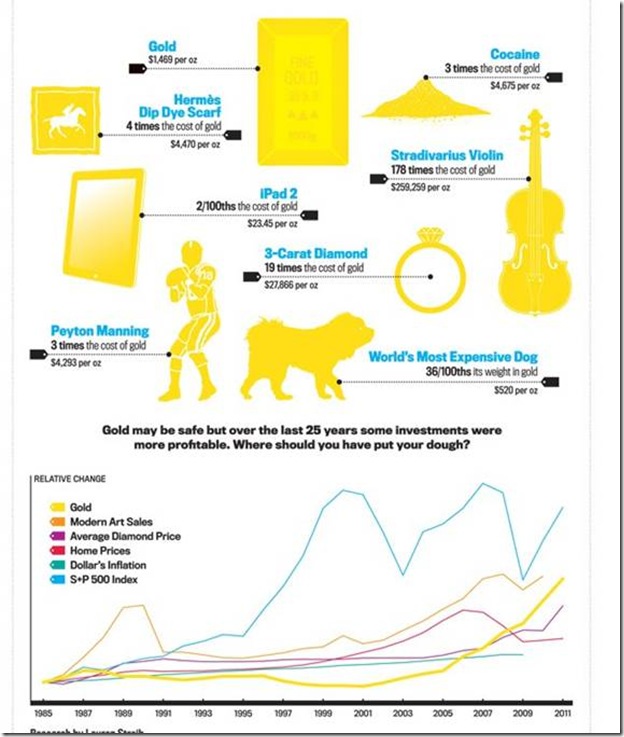
Gold and Silver have been on the top pages of many trade magazines; now it has started to appear on normal (lay people’s) magazines. The above graphic is from Newsweek…..When articles appear in abundance on magazines for the layman, it usually signals a market top or bottom of the underlying asset class. It is the peak of emotion that gives the final ‘uumph’ to the underlying asset class, and marks the top or bottom. Gold and silver are approaching such levels, leading to possible corrections. So, what actually happened?

The Dollar Index slipped to 73.735 on April 21 (and again lower on April 27), the lowest since August 2008, which really is fore-telling that the confidence in the US dollar is fading. So, is the move in gold completely a reflection of the dollar’s under-performance? Yes. Correlation has been uncanny this year - U.S. Dollar Index has fallen 6.3% since the end of last year while gold bullion has risen 6.2%!!!

Silver has more than doubled over the past year as investors rode after silver as a store of value amid speculation that China will buy gold and silver to diversify its foreign-exchange holdings.

As every speculation that mankind has experienced has come to an end, the gold bugs are concerned too. Tulip mania, Y2K reprogramming, Internet revolution, Housing boom from 2000-2006 (see graph below), FII moving billions to Emerging Markets (see graph below of crash in 2008), US being crushed under debt, US$ on a big decline etc. The concern of gold bugs is not just theoretical either. Many expect the dollar to stage a comeback after the U.S. Federal Reserve brings its monetary stimulus program — its second round of quantitative easing (QE2) — to an end this coming June 30 ’11. As interest rates are also supposed to bump up at some point in time to combat the inflation created by oil/depreciated-dollar, we will start seeing some strength in the US$. Indeed, some are anticipating that the rally could begin as soon as June-July, depending on the outcome of the Fed’s meeting. Will it last?

clip_image002

clip_image002[5]

Technically, the meteoric rise of gold and silver is a concern, which foretells a correction of some magnitude. Volatility is growing and the exponential rise is happening now. Compounding it with the economic event of QE2 ending, might be simply a convergence of events that might create a buying opportunity for gold bugs or the people who feel left out…..This might look like a bearish view from me, but it really is a cautionary view. This means that buying more at these prices is not warranted unless you are a short term trader. What do you think?

Disclaimer: I am still holding gold/silver bullion, numismatic coins, Gold ETF and gold/silver/diamond jewellery as one of the asset classes in my portfolio.

-------------------------------------------------------------------------------------------------------------

KKP (Kiran Patel) is a long time investor in the US, investing in US, Indian and Chinese markets for the last 25 years. Investing is a passion, and most recently he has ventured into real estate in the US and also a bit in India. Running user groups, teaching kids at local high school, moderating a group in the US and running Investment Clubs are his current hobbies. He also works full time for a Fortune 100 corporation.

Selasa, 15 Februari 2011

Planning for a hassle-free Retirement (a guest post)

Do you remember what you did with your first pay/payment cheque? (Haven’t received your first cheque yet? What are you doing on this page!) Did you blow it up having a good time with friends and family? Why not? You don’t remain young forever. There is a long and bright future ahead of you – and plenty of time to save and invest. Right?

Nishit doesn’t think so. He started planning for his retirement as soon as he received his first pay cheque. He wanted to use the leverage of compounding over his entire working life. In this month’s guest post, he explains why.

-------------------------------------------------------------------------------------------------------------

Everyone invests money with the aim of having a comfortable nest egg at retirement. Most of us have not worked out how much money we need at retirement, and at what rate of return we will be comfortable. Most of us chase multibagger returns in the equity markets, burning our fingers in the process.

The magic of compounding is such that 1 lakh invested in the markets today turns into 19 lakhs after 20 years at a rate of 16% return every year. To make 16% every year your asset portfolio need not take undue risks. A Government securities fund over the past 10 years has given a compounded return of 9% on an annualized basis, and a good mutual fund like the HDFC Top 200 has given annualized return of 34% over the past 10 years.

Inflation is a monster which is like a silent killer. Now assuming an inflation rate of 8%, after 20 years, expenses of 1 lakh become 4.66 lakhs. Your assets of 1 lakh have transformed into 19 lakhs whereas the expenses have just gone up to 4.66 lakhs. You have a nice cushion of 14 lakhs.

Gold as an asset class has also yielded an annualized compounded return of 17% over the past 10 years. The trio of equity, gilt funds and gold should form the cornerstone of any investment portfolio. What I am trying to point out here is that investments need not be complex; any common person can invest making use of investment vehicles like Mutual Funds.

The above returns are through investments using the SIP (Systematic Investment Plan) method. One can invest a fixed amount every month, say Rs 5000 each, in a gold ETF, equity fund and a Debt fund. The idea of doing this is that you do not try and catch the bottom or top of any market. One need not invest in too many funds at one go.

India’s economy is growing and will continue to do so for the next 10 years at least. Anyone who is planning to retire with a comfortable income must start doing a SIP at the earliest. By doing this, one can ensure that one is financially independent after retirement. Add to this a Medical Insurance policy that will cover major health care expenses post retirement. The earlier one buys a Medical Insurance policy the fewer are the tests one has to undergo and easier it is to get one. Everyone should have a personal medical health insurance policy, as company policies expire when one leaves the company.

-------------------------------------------------------------------------------------------------------------

(Nishit Vadhavkar is a Quality Manager working at an IT MNC. Deciphering economics, equity markets and piercing the jargon to make it understandable to all is his passion. "We work hard for our money, our money should work even harder for us" is his motto.

Nishit blogs at Money Manthan.)

Related Posts Plugin for WordPress, Blogger...