Tampilkan postingan dengan label stock market. Tampilkan semua postingan

Selasa, 13 Maret 2012

The truth(?) behind the 6.8% Jan ‘12 IIP growth number

The Index of Industrial Production (IIP) published by the government each month is supposed to give an idea about what is going on in the economy. The Jan ‘12 figure of 6.8% came as a positive surprise, because the IIP number for Dec ‘11 was only 2.5%, and the consensus estimate for Jan ‘12 was about 2.1%. Naturally, the much higher figure seemed to indicate that growth was returning to the Indian economy.

The stock market should have celebrated the news – but didn’t. Were market participants ‘selling on news’, or did they ignore the news as unbelievable? Digging a little deeper into the published data raises more questions than answers.

Manufacturing growth was at a respectable 8.5%. But that growth was largely due to a whopping 92.6% growth in food products and beverages; 56.1% growth in printing, publishing and reproduction of recorded media; and 29.9% growth in medical, precision and optical instruments, watches and clocks. Minus these three items, manufacturing growth would be negative.

In plain English, the above data means that Indian citizens consumed almost twice the amount of food and drinks than what they did in Jan ‘11. Surely, population increase and rural prosperity through the NREGA scheme had roles to play. But 92.6% growth is hard to believe. So is the data that indicates a sudden rise in reading books, newspapers and listening to music and watching movies at home.

A growth in medical instruments may be explained away by the proliferation of modern hospitals and clinics. But why the propensity for buying watches and clocks? Of course, the published data has the following disclaimer: “Indices for January ‘12 are Quick Estimates.” May be the data collection was outsourced and improperly supervised.

More intriguing are the areas of de-growth. Electrical machinery and apparatus fell by –30.5%. Office, accounting and computing machinery fell by –14.1%. Radio, TV and communication equipment and apparatus fell by –13.8%. India is definitely not shining if electrical machinery, computers and communication equipment are showing de-growth.

As happens almost every month, these ‘Quick Estimates’ get revised subsequently. Which means these initial numbers don’t count for much and don’t indicate any trend. The collective wisdom of market participants in ignoring the Jan ‘12 IIP growth number proved correct in this instance.

Kamis, 08 Maret 2012

Behavioural traits of a successful investor

To be a successful investor in the stock market, one needs to develop several skills:

  • Learn how the stock market functions – the roles played by short-term traders, long-term investors, operators, company promoters, brokers, FIIs, DIIs, NSDL/CSDL, stock exchanges, SEBI
  • Know about the various types of securities that are traded – stocks, convertible and non-convertible debentures/bonds, warrants, ETFs, mutual funds, bonus/rights shares, bonus/rights debentures
  • Be aware of related information – dividends, interest on debentures/bonds, tax implications of buying and selling of various securities
  • Have working knowledge of economic concepts – supply and demand, money supply, inflation/deflation/stagflation/recession, surplus/deficit, interest rates, impact of global economies on domestic economy, effect of economic changes on different business sectors
  • Reasonable proficiency in accounting concepts – debit/credit, assets/liabilities, capital/reserves, equity/preference shares, payables/receivables, raw materials/inventory, profit/loss, cash flows, and ability to calculate and compare EPS, P/E, P/BV, RoNW, RoCE, Debt-Equity ratio, etc.

But the most important skill of all is to learn about oneself – the behavioural traits that determine who will be a successful investor and who will be an ‘also ran’.

In a recent article posted at investopedia.com, the following behavioural model developed by Bailard, Biehl and Kaiser was presented:

Investors are classified according to their decisions and actions (‘impetuous’ at one end and ‘careful’ at the opposite end) as well as their levels of confidence (‘confident’ at one end and ‘anxious’ at the other end). Based on these behavioural traits, investors are divided into five groups:

  • Celebrity – anxious and impetuous, a follower of the latest investment trends
  • Adventurer – confident and impetuous, a strong-willed risk taker
  • Individualist – confident and careful, with an analytical and self-reliant approach
  • Guardian – anxious and careful, willing to sacrifice riskier growth for more stable returns
  • Straight Arrow – equally shares the above four behavioural traits

Apparently, greatest investment success is achieved by those with the ‘Individualist’ behavioural trait. What if one has one of the four other behavioural traits? Should they exit from the stock market?

With discipline and perseverance, behavioural patterns can be changed – provided one is aware which behavioural category one belongs to.

Moral of the story? To be a successful investor – know thyself.

Related Posts

Become a successful investor by avoiding 'herd mentality'
Are you an irrational investor?
Some practical examples of Behavioural Finance

Rabu, 29 Februari 2012

Is the Q3 GDP growth rate of 6.1% a good or a bad number?

The short answer to the question: It depends on your viewpoint. Such a GDP growth number can not be seen in isolation, but in comparison with what has happened before and what is happening elsewhere.

Here are a few reasons why the number is good, and a few more reasons why the number is bad. The idea is not to confuse readers, but to provoke thinking and debate.

Reasons why Q3 GDP growth of 6.1% is good

If you look at the growth figures in some of the developed economies – particularly those in the Eurozone where even a 2% growth figure is considered gooda 6.1% growth figure should be celebrated with fireworks and champagne. The stark difference in growth figures is one of the reasons FIIs are investing big sums in our stock market.

High growth usually leads to inflation and therefore, high prices for goods and services. A more moderate growth figure has helped to tame inflation to a certain extent.

The Q4 GDP growth figure is unlikely to be much higher, but things are likely to improve from here on as there is usually a spurt in spending by the government sector to utilise left over funds from the previous year’s budget. In other words, the economic cycle may be bottoming out – which it usually does a few months after the stock market bottoms out.

Reasons why Q3 GDP growth of 6.1% is bad

This was the lowest growth figure in nearly 3 years, and almost 35% lower than the heady figure of 9.5% growth seen 5 years back.

There is evidence of economic slowdown everywhere – particularly in the manufacturing sector. Even services sector is slowing down. If growth doesn’t pick up soon, the FIIs may just pull out their money and invest it elsewhere.

Government’s fiscal deficit target for the year has already been exceeded in the first 10 months. That, coupled with the rise in oil prices, means that inflation may rear its ugly head again. The RBI may feel constrained to leave interest rates at the current high levels, or reduce it only marginally. That in turn will lead to slow growth in the next financial year.

Selasa, 28 Februari 2012

Notes from the USA (Feb 2012) - a guest post

The data flowing out of the US economic indicators have been showing definite signs of recovery from the world-may-come-to-an-end kind of scenario three years ago. Two large doses of Quantitative Easing have prevented a collapse of the financial system. The stock market is soaring and corporate America is flush with cash. Unemployment situation is improving and even the moribund housing market is beginning to show signs of life.

Is this the proverbial light at the end of the tunnel, or is it the headlight of an onrushing train? In this month’s guest post, KKP expresses his apprehensions about the strength and durability of the US economic recovery. He also presents a positive outlook from a recent consumer survey report.

-------------------------------------------------------------------------------------------------------------

Beautiful Orange Sky Before Darkness

The sky looks awesome right now since it is 6 pm and we can see the sun setting on the horizon. It is a perfect time when the glare of the sun does not bother our eyes, the heat has reduced to a more comfortable level, and it is all-in-all pleasant to everyone enjoying this moment. The key is to know what happens in a few minutes to an hour. It will be dark and the lights need to turn on. Oh no, the electricity man came earlier and cut off our electricity? Is that possible? Turning to my wife, I ask if we paid the electric bill on time? Huh!

Well, it seems that we are facing such an evening right now in the global economy. The bearish blog writers have portrayed well that ‘patch-work’ solutions of the current debt-related issues are only going to take us so far. One fine day the electricity guy is not going to take our cheques (or bonds) and the darkness is not going to get illuminated with a 100 or 200 watt CFL (tube light) bulb.

Many global economies are running on borrowed time, with times of pleasure and growth in between based on government maneuvering for political reasons. Is the booster shot that Greece just got something that will last, or will it need a 2nd, 3rd, and 4th shots before the antibiotics kick-in? And will the patient be alive when those 3rd and 4th shots are given? Are the other countries after Greece in the PIIGS acronym next to ask for rescue packages? Of course, they are almost ready now. We already have a next acronym after PIIGS and it is CAASH. This is the Canadian, Australian, Hong Kong and other economies that also have their Debt-to-GDP ratios going out of whack. US tax collections are lower than ever, and annual deficits are in the same range as during 1929-1934 (% of GDP). Are we so information overloaded that we cannot see the turmoil in the air, or are we too busy with our daily chores, ‘synch’ing our mobile devices, and playing Angry-Birds on our Tablets/iPhones/Androids?

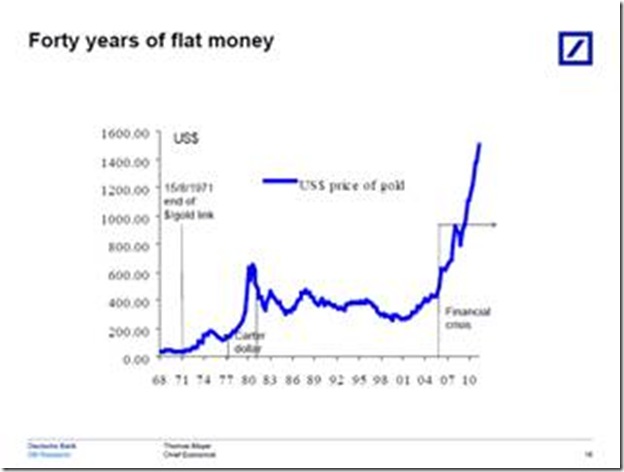
Take a look at the previous crisis and what happened to Gold. Look at what has happened to Gold even without a ‘real crisis’. I say that the crisis has not happened since we keep averting the ‘root cause’ event with patch-work. In the meantime, we have high tides and low tides in the market and have the emotional roll-coaster associated with it (being left out, or what did I do!). So, let’s watch what is happening in the global markets and react accordingly.
clip_image002

If you want to see a positive viewpoint of the most current survey that I participate in with ChangeWave, here is partial report. Of course, I was not very optimistic in my input to the survey. We are approx 5000 to 10000 people in this closed group of professionals that provide our input based on our consumer spending or enterprise spending surveys. It will show the minor waves of positive and negativity, and of course, it is showing the positive/optimistic living that we are all experiencing right now. I am all for good living, and benefitting from positive waves, but will it last?

-------------------------------------------------------------------------------------------------------------

February U.S. Consumer Spending Report

Spending Accelerates for February as Consumer Confidence and Expectations Improve

by Jean Crumrine and Paul Carton

Overview: In a clear sign of accelerating momentum, U.S. consumer spending has soared in February – the second major upswing of the past three months. Importantly, the February 1-13 ChangeWave survey shows overall spending at a nine month high, and confidence and expectations continuing to improve. ChangeWave Research is a service of 451 Research.

The survey of 2,501 U.S. consumers finds the biggest spending upticks are occurring in Travel/Vacation, Household Repairs and Improvements, Autos, and Restaurants.

Moreover after last month’s post-holiday declines, our latest findings point to renewed momentum for several retailers, including Costco (COST), Target (TGT) and Walmart (WMT).

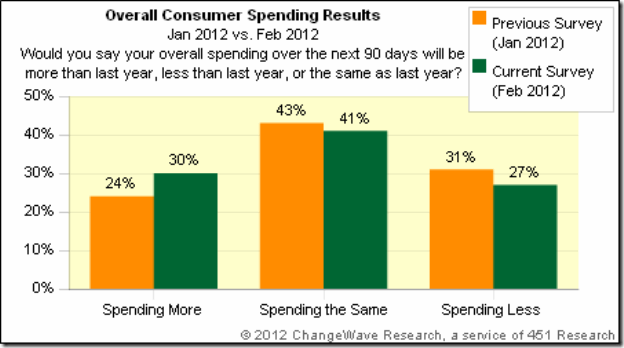
Consumer Spending Outlook: Three-in-ten U.S. respondents (30%) now say they'll spend more over the next 90 days than they did a year ago – up 6-pts since our previous ChangeWave survey in January.  Only 27% say they'll spend less, a 4-pt improvement from previously.
clip_image001

Putting the Findings in Context:  As the following chart shows, the net 10-pt jump in February is the second major uptick of the past three months – and the overall reading is higher than any of the previous 9 months.

clip_image001[4]

Consumer Expectations and Confidence: When we asked consumers about their impressions of the economy, we found confidence and expectations up again to their highest levels of the past year.

Consumer Expectations:  One-in-three consumers (33%) now believe the overall direction of the economy will improve over the next 90 days, while only 21% think it will worsen.  This represents a net 7-pt improvement since January and a striking 66-pt turnaround since the horrendous lows of six months ago.

clip_image001[6]

Stock Market Confidence:  In a similar positive, 39% say that they’re More Confident in the U.S. stock market than they were 90 days ago, while 19% say they’re Less Confident – an 8-pt improvement since the previous month.

clip_image001[8]

Respondents were asked about their investing plans going forward, and reported their money inflow into U.S. Stocks (+13; up 6-pts) is accelerating. And although Non-U.S. Stocks (-1; up 6-pts) are still registering a money outflow, the rate is subsiding – a sign that the European Union debt crisis hasn’t immobilized consumer investing.

Bottom Line: The February ChangeWave survey results show consumer spending soaring, and bring into sharp focus the improved spending environment we’ve been tracking in our monthly surveys since November of last year.

Importantly, U.S. consumer confidence and expectations are also improving for the 6th consecutive month. As for the biggest outperformers in February – it’s Travel/Vacation, Autos, Household Repairs/Improvements, and Restaurants.

-------------------------------------------------------------------------------------------------------------

KKP (Kiran Patel) is a long time investor in the US, investing in US, Indian and Chinese markets for the last 25 years. Investing is a passion, and most recently he has ventured into real estate in the US and also a bit in India. Running user groups, teaching kids at local high school, moderating a group in the US and running Investment Clubs are his current hobbies. He also works full time for a Fortune 100 corporation.

Selasa, 14 Februari 2012

A common investing mistake - and its remedy

A common investing mistake made by many small investors is to wait far too long, and let buying or selling opportunities slip away. When the stock market is rising, and portfolio values go up in leaps and bounds, the tendency is to hang on to the stocks or funds in the portfolio to try and squeeze out the maximum amount of profit. The wait to sell keeps getting longer and longer and one fine day, the market cracks for no apparent reason. The investor rues the fact that a selling opportunity near the top was missed.

When the stock market is falling, the same psychology plays out in reverse. Investors try to buy a selected stock or fund at the lowest possible price, and keep waiting and waiting to buy at even lower prices. Out of the blue, the market turns and starts to rise - as if throwing caution and common sense to the winds. A buying opportunity near the bottom is missed.

Seasoned professional investors find it tough to correctly time stock market tops and bottoms. Imagine how much more difficult it is for amateur investors to catch market tops and bottoms. It is not worth trying unless one has become adept at identifying technical signals - and that takes years of practice.

There is a simple way to remedy the mistake of waiting too long and losing opportunities. Inculcate the habit of being fully invested. Regardless of whether the stock market is moving up or down. But it requires a bit of planning and a large dose of discipline. First of all, investors require a financial plan based on their income, savings and existing and future financial commitments. Help can be sought from a professional financial planner (for a fee) or a CA friend (for free). But it isn't rocket science. Knowledge of Class 5 arithmetic is good enough to do it yourself.

Then one needs an asset allocation plan, based on risk tolerance. This post explains the concept of an asset allocation plan. Once the plan is in place, investors should have the discipline to stick to the plan at least for two or three years. Change the plan only if things don't work out. Investing without a plan is like travelling without a destination.

If the asset allocation plan indicates it is a good time to buy (because the equity portion of the allocation has fallen below a pre-set threshold level), start buying systematically. By using cost averaging or value averaging concepts. Read about these concepts in this post. Identify a couple of good stocks or funds. Then decide how much of each you want to buy value-wise. Spread out the buying over a few months, till your asset allocation plan is rebalanced.

If the asset allocation plan indicates it is time to sell (because the equity portion of the allocation has exceeded a threshold level), don't wait any longer. Start booking profits partially. To find out more about partial profit booking, read this post. Remember to keep the flowers and cut the weeds in the portfolio first.

Kamis, 02 Februari 2012

10 Questions about Supreme Court's cancellation of 122 2G telecom licences

In a historic judgement today, the Supreme Court has cancelled 122 2G telecom licences issued irregularly during the tenure of the former Telecom minister, A Raja (currently cooling his heels in a government hospitality center). The judgement was hailed by all concerned. After an initial dip, even the stock market celebrated by closing higher.

The judgement raises several questions. Here are 10 of them. Knowledgeable or enlightened readers are welcome to provide some answers.

1. By cancelling the licences, is the Supreme Court pointing the finger of blame towards the UPA government?

2. Isn't the business community equally to blame for trying to get something for nothing (well, not exactly nothing)? What happens to the not-exactly-nothing passed on to the badminton-playing government guest at Tihar jail?

3. Many of the 2G licences were acquired with no intention of providing any services, but merely to sell them off to others at huge profits - defrauding the government exchequer. Who will recover the immoral profits, and how?

4. A new licencing process will be formulated over the next 4 months and the licences will be reissued. Who will ensure that the new process will not turn out to be 'A Raja - Part 2'?

5. What happens to the licence fees already paid by the cancelled licence holders? Will those fees be forfeited?

6. What if some of the cancelled licence holders do not bid in the new process? Will the existing licence holders (whose licences have not been cancelled) be allocated extra spectrum?

7. Most of the licence holders borrowed money from the banks to launch their services. Will those loans become NPAs? Is that the reason why the Bank Nifty took a dive?

8. The Supreme Court judgement must have sent shivers through the spines of foreign investors in the telecom sector. Will FDI flows into India - badly needed to get our economic engine revving again - get affected by this judgement?

9. The charges against P Chidambaram brought by Subramaniam Swamy will be judged by a lower court later this week. If the judgement is adverse, can it bring down the UPA government? If yes, will the stock market crash?

10. Will the Supreme Court judgement open up a proverbial Pandora's box? Will all scams - whether in mining, CWG, Adarsh Housing, fodder - come under the Court's scanner? Will that be good or bad for the country?

Some of these questions may get answered over the next few days, as the government assesses the detailed judgement and formulates its plan of action. Till then, it will be good to hear what readers think.


Selasa, 24 Januari 2012

Did the stock market over-react to the 50 bps CRR cut by RBI?

The short answer to the question is: Yes. The CRR rate cut is good news, but not great news. Great news would have been a cut in the repo and reverse repo rates. Now, the long answer.

Imagine that you are a farmer in central India, and it is the middle of April. With poor access to irrigation facilities, your crop is dependent on the monsoon rains. Your cousin from the nearby town comes to visit you and mentions that it was announced on the TV that monsoon may set in a week early in the middle of June instead of the third week. No doubt, that would be good news. But the rains will still be two months away.

RBI's announcement is somewhat similar. The CRR rate cut is an indication that repo and reverse repo rates may be reduced two months down the road. So, today's high volumes may be a sign of a buying climax.

What is the CRR and what purpose will be achieved by cutting it from 6% to 5.5%? Cash Reserve Ratio (CRR) is a percentage of the total deposits in a bank that has to be maintained as a 'reserve' with the RBI. It is one of the monetary instruments used by the central bank to regulate the money supply in the financial system.

Due to the aggressive interest rate increases by the RBI to contain inflation, growth has started to slow down. In fact, the RBI has now set the GDP growth target for 2011-12 at 7% - down from earlier revised target of 7.6%. Much lower than the glory days of 9-10%. India Inc. have been complaining that growth was being sacrificed to control inflation. Now that inflation rate has finally started to moderate, RBI has taken the first step by increasing the liquidity in the financial system.

How does it work? Let us say, a bank has Rs 10,000 Crores as deposits. A 6% CRR implies that Rs 600 Crores have to be maintained as a 'reserve' with RBI. That means, the bank has access to only Rs 9400 Crores that it can give out as loans. A 50 bps (i.e. 0.5%) cut in the CRR leaves the same bank with access to Rs 9430 Crores to deploy gainfully. On the extra Rs 30 Crores, the bank can expect to generate an additional Rs 3 Crores in profit.

The overall cash infusion into the banking system is expected to be about Rs 32,000 Crores, which can be loaned out to generate a profit of say Rs 3200 Crores. Not a small sum, but not a king's ransom either. Now you know why the bank stocks rose today. But that is the theoretical view point. What is likely to happen in real life?

Is India Inc. going to break down the doors of banks to apply for loans? Highly unlikely. Remember that the interest rates remain just as high as it was two months back, when no one was taking loans and were postponing capital expenditure. Banks are also struggling to contain their NPAs and have become quite rigid in doing due diligence before handing out loans. Add to that the likelihood of the inflation fires getting stoked by the excess liquidity in the system. There is also 'hidden' inflation due to large subsidies.

All in all, definitely not a cause for celebration. The RBI governor clearly put the ball in the government's court by pointing out that fiscal profligacy is one of the major causes of inflation. Unless core inflation falls further, do not expect a cut in the repo or reverse repo rates in a hurry.

Related Post

How to use Financial News

Jumat, 20 Januari 2012

5 reasons why this is a sucker’s rally and not a change of trend

P. T. Barnum, a 19th century American circus owner, had apparently said: “There is a sucker born every minute.” Translated into English, that means that the world is full of gullible people. Any idea, however ridiculous and unbelievable it may be, is sure to find a few takers.

Crazy ideas - from ‘the world is flat’ and ‘the sun moves around the earth’ to ‘Suzlon is the next GE’ and ‘RJ is the Warren Buffett of India – follow his portfolio if you want to become rich’ – always find believers (a.k.a. ‘suckers’).

So, what is a “sucker’s rally”? It is a sharp price rise in an index or a stock without the support of fundamentals – usually during a bear market. Here are 5 reasons why the current rally in the Sensex and Nifty indices is a sucker’s rally:

1. There is a ‘gut feeling’ among small investors that the worst is over. Gut feelings are seldom right, unless the guts belong to some one called Warren Buffett. Even Buffett is known to make mistakes. Keep your guts where they belong. Use your brains instead. The problems in Europe haven’t been solved yet. China’s economy is struggling with slower growth. The worst may not be over yet.

2. A general consensus among market players is that RBI may start reducing rates soon; even if the interest rate remains where it is, there is likely to be a cut in the CRR to increase liquidity. The RBI has not indicated any such thing. They have only paused in hiking interest rates further. That means, interest rate remains just as high as it was a month ago when the Sensex and Nifty hit their lows. Stock markets can’t sustain in a high interest rate environment.

3. Though food inflation has started coming down, it may be more due to a high ‘base effect’ and seasonal availability of vegetables. Core inflation has moderated a bit, but still remains high. RBI has made it quite clear that controlling inflation is their top priority. Unless core inflation drops below 5%, interest rate cuts may not be effected. Inflation won’t come down as long as the government spends recklessly on various schemes to buy votes.

4. The government’s policy inaction will continue till the annual budget is announced in mid-March – thanks to the impending elections in five states. The only bit of good news for foreign investors in recent times has been the Supreme Court’s judgement in the Vodafone case, stating that the Income Tax department has no jurisdiction over a transaction between two overseas entities. But that judgement is more in the nature of removing an unnecessary irritant than paving the way for any fresh investments. The government has to be far more proactive on the policy front to change the commonly held perception that it is bureaucratic and inept.

5. Technically, both the Sensex and Nifty are in 14 months long bear markets. Bear markets (and bull markets) don’t turn around suddenly. They usually form some sort of a reversal pattern, which takes a few weeks to a few months to form. No such reversal pattern is visible as yet.

The recent spate of FII buying has begun to attract inexperienced small investors who don’t want to miss the bus. Technical indicators are looking overbought. The stage seems set for the big boys to get out. The suckers may get stuck with shares bought at higher prices.

Rabu, 18 Januari 2012

Should you invest in large-cap or mid-cap stocks?

The stock market has been in a down trend for more than a year – losing 25% from its Nov ‘10 peak. Experts suggest that such falls provide excellent opportunities to accumulate strong large-cap stocks. Large-cap stocks are less risky and offer steady rather than spectacular returns.

Most small investors have a penchant for seeking out small and mid-cap stocks in the hope of making multi-bagger returns. But high returns are usually accompanied by high risks. What should small investors do? How to contain risk without missing out on returns?

In this month’s guest post, Nishit looks at the pros and cons, and comes up with an alternative approach.

----------------------------------------------------------------------------------

The argument will always continue whether to invest in large-cap or mid-cap stocks. One of my friends was asking me this morning whether it would be a good idea to invest in mid-cap IT stocks. It was the trigger for this post.

Mid-caps have several advantages. They are the real multi-baggers. Microsoft and Infosys were mid-caps once upon a time. Mid-caps can be a 10-bagger or even a 100-bagger. Mid-cap stocks carry a greater amount of risk as compared to large-cap stocks. In a bear market, a large-cap may lose 50% of its value whereas a mid-cap can lose as much as 90-95% of its value.

So, how does one address this conundrum? Every portfolio needs to be garnished by a sprinkling of mid-cap stocks, just like our food needs a sprinkling of salt to add to the taste. Just as too salty food is not good for health or taste, too many mid-caps is not good for the health of your portfolio, which leans towards risk.

How does one identify good mid-cap stocks? There are several criteria one must keep in mind.

  1. They should have sound business models.
  2. They should be generating real profits.
  3. They should have good management. This is a very tricky question. How does one see a management to be good? A small investor cannot go and meet the management of a company he likes. One must look through the annual reports and notifications of the stock exchanges. The promoters should not have a shady reputation, or indulge in activities that harm shareholders – such as pledging of shares or dazzling announcements aimed at TV and newspapers.
  4. The companies should be generating positive cash flows and providing steady dividends. Steady dividends can be ignored if the business is growing and the promoters are not investing the money in unrelated activities.

Now that we have looked at what criteria to use in selecting a good mid-cap company, the next question is when to invest. In bear markets, mid-caps are battered beyond recognition. Hence, one can follow this strategy. Keep accumulating large-cap stocks on every dip.

For mid-caps, buy only if the Nifty sustains above its 200 day Moving Average for a week or more. 200 day Moving Average is considered the dividing line between bear and bull markets.

Also, depending on one’s risk profile, the allocation has to be done between large-cap and mid-cap ideas. A conservative portfolio can have a 80:20 ratio between large and mid-caps. A more aggressive portfolio can have 60:40 ratio between large and mid-caps.

----------------------------------------------------------------------------------

(Nishit Vadhavkar is a Quality Manager working at an IT MNC. Deciphering economics, equity markets and piercing the jargon to make it understandable to all is his passion. "We work hard for our money, our money should work even harder for us" is his motto.

Nishit blogs at Money Manthan.)

Sabtu, 31 Desember 2011

eBook: Technical Analysis – an Introduction

As regular readers already know, I have been writing a blog for more than 3 years to educate new investors about investing in the stock market. The experience so far has been quite enriching for me, and hopefully, beneficial for some of the readers.

The stock market can be a fascinating place or a fearsome place – sort of like bathing in the sea. The first few attempts are usually quite humbling – specially if the sea has large waves that keep constantly crashing on to the shore.

The uneducated can get thrown and dashed around by the waves – hurting pride and self-confidence. In extreme cases, the sea waves can drag out the hapless to a watery grave.

To the experienced sea bather, there can be nothing more exhilarating, invigorating and even relaxing. Jumping up to let the smaller waves flow through, diving under the really big breakers, then swimming out and letting the waves gently carry you back to shore is great fun and builds up a healthy appetite.

Likewise for the stock market. The inexperienced buy to find their stock going down, sell to find the stock going up, spend sleepless nights thinking how to salvage their losses – and in extreme cases, commit suicide.

Of those who have been through the experience, some leave the market permanently blaming brokers, operators, market manipulators, friends who gave wrong tips – in fact any one except themselves. Those who stick around to fight another day, try to learn the ropes by reading, or following the advice of experienced market players.

My earlier eBook: How to become a better investor, was published exactly two years ago on New Year Eve. It contained general advice about sector and portfolio selection, and strategies about how and when to invest without losing a lot of money. Several hundred eBooks were emailed – and may have helped a few readers to become better investors. That eBook is now being ‘retired’ – it will no longer be emailed, but will be available for reading on a different blog.

Many of the posts on this blog are about technical analysis of chart patterns. Several readers had requested me to write an eBook on technical analysis, so that the important information can be available easily in one place. After remaining on the anvil for nearly a year, it is finally ready.

Like the previous eBook, this one is also being provided to my blog readers for free - but on two conditions:

First, you need to specifically ask for the free eBook by sending me an email at mobugobu@yahoo.com with your full name. Hiding behind a pseudonym won't help! I would like to avoid spammers to the extent possible.

Second, you can ask your friends, relatives, colleagues to send me an email for the eBook (or send them a link to this blog post) - but please do not forward the eBook to others without my permission. I don't want the eBook to be freely circulated over the Internet.

The eBook has been compiled from selected blog posts and some new material. It is meant to be an introduction to the subject of technical analysis, with a handful of important concepts that are more than enough to arouse the curiosity of those who want to learn more.

2011 has been a disappointing bearish year for most small investors. Please consider this eBook as a small gift towards making 2012 a happier and more prosperous year. Needless to say, your comments and feedback will be most welcome.

Selasa, 27 Desember 2011

10 Reasons why small investors should love a bear market

Most small investors detest a bear market. The helpless feeling of watching stocks bought with hard-earned money falling into oblivion can be quite traumatic, and cause sleepless nights.

In a desperate and misguided effort to salvage a losing position, investors start ‘averaging’ – buying more shares at progressively lower prices. The stock doesn’t know that some one is ‘averaging’ it – and keeps going down further! The ‘average’ price of the stock decreases, but the losses increase.

Is there any remedy for this fairly common ailment? Turn a disastrous situation into a learning experience. Find out the reasons why small investors should love a bear market. Here are 10 of them.

1. Every one loves bargains. The best bargains in stocks are found during a bear market. Good stocks are available at 40%-50%-60% discounts to their recent peak values.

2. Experts and analysts appearing on TV or writing in business papers stop recommending third rate stocks. They may actually discuss about some decent companies. No longer will you hear that Suzlon is a great buy or Bartronics is the next Infosys.

3. Email or cell phone inboxes will not get overloaded with SMS stock tips about unknown companies from unknown brokerage houses. Most of those brokerages go belly-up during a bear market.

4. No one wants to discuss about stocks at weddings or college reunions. One can actually have intellectually stimulating conversations with relatives and friends – instead of saying “I’ve bought this” or asking “Why did you sell that?”

5. Working hours will not be wasted by staring at stock tickers scrolling on computer terminals. Up to the minute stock updates on cell phones will get disabled. Productivity at work places will improve.

6. One can get a haircut or a shoeshine in peace without getting stock tips from the barber or the shoeshine boy.

7. A bear market separates the short-term, one-hit rock-star companies from the true long-term wealth creating companies. The stocks that don’t fall much in a bear market are the ones that provide dividend income and stability to your portfolio.

8. If one is unfortunate enough to come face to face with a bear in a forest, the best thing to do is not to run or try to fight but to play dead. In the stock market, one can play dead by investing in fixed income avenues. Interest rates are usually higher at such times.

9. The importance of proper asset allocation becomes clear. Spreading investments among equity, fixed income, gold and cash not only saves a portfolio from annihilation but the asset allocation gives clear signals about when to buy and when to sell.

10. A bear market tests an investor’s mettle. Those who turn tail and run are just not meant to be successful investors. Those who can stick it out and learn from their mistakes are the ones who may be able to build wealth over the long term. 

Kamis, 22 Desember 2011

Are you ready to splurge at the discount sale in the stock market?

Discount sales in retail stores happen several times during the year. They advertise ‘buy-one-get-one–free’ sales and ‘upto 50% discount sales’ that bring in buyers by the hordes. If you have ever visited a retail store on the last day of such a sale, you will find a scene of utter devastation – stuff strewn all over the place and buyers practically yanking things off other buyers in a last desperate bid to find a bargain buy.

What is interesting is that the same buyers (or their friends or cousins) become completely reticent when a discount sale is going on in the stock market – keeping their wallets glued to their pockets. No one rings a bell or takes out full-page advertisements in newspapers to announce a sale in the stock market. One fine day, when everything seemed to be full of sunshine and happiness, people realise their stock or mutual fund portfolio is decreasing in value. Stocks and funds that were flying into orbit suddenly start to nose-dive.

The initial reaction is usually denial. This must be a temporary phase. The correction will soon be over. Experts suggest: “Buy the dip”. Those who entered a bull market late (they are mostly new investors attracted like flies to a pot of honey) start ‘averaging’. When the stock market continues to fall, denial is replaced by shock. All the ‘averaging’ does not prevent a stock’s price from crashing. In sheer panic, investors sell off their holdings to recover whatever little they can.

That is when the real sale starts in the stock market. Experts opine that the index can’t fall any more; 4700 or 15700 or some such number should be the bottom; this is a good time to buy into blue chips. And then the stock market decides to offer even better discounts! But where are the buyers? Why aren’t they falling over each other in trying to lock-in the best bargains?

Many years ago, in a training class on the art of selling, I learned two important lessons. The first lesson: When some one leaves you a message stating that the ‘matter is very urgent’, the urgency is the person’s who left the message. He has probably not yet met his quarterly or yearly sales target – which means no bonus payment and may be even a ‘pink slip’. Don’t call the person back. Let him call again.

The second lesson: When some one offers you a very good deal – so good that you are tempted to whip out your cheque book – smile politely and refuse. The deal will usually get even better! Those who have negotiated a car purchase – particularly a second hand one – will know what is being discussed.

The same goes for Mr Market. He announces discount sales only once in two or three years – not several times a year like retail stores. But if you have the patience and skill to ‘negotiate’, keep smiling and refusing to accept his offers. Even if strong performers are trading at 52 week lows. You will find that his offers get even more mouth watering.

At some stage, Mr Market will get fed up with you (and others like you) and start increasing prices – not in one shot, but gradually. Much like the way he kept offering better discounts with each passing week. That is the best time to start buying. You may not get the absolute lowest bargain price. But you can sleep peacefully at night knowing that henceforth, prices will start rising. 

Jumat, 16 Desember 2011

RBI pauses interest rate hikes – why did the stock market dive?

Stock markets and interest rates have a love-hate relationship. Markets love low interest rates, but detest high interest rates. ‘Low’ and ‘high’ are relative terms. As a very rough thumb rule, a Repo rate of 5% or lower can be taken as a ‘low’ rate; 7% or higher can be considered a ‘high’ rate.

In Jul ‘08, the Repo rate (the interest rate payable by commercial banks when they borrow money from the RBI) had peaked at 9% – more than 6 months into the previous bear market that lasted from Jan ‘08 to Mar ‘09. Thereafter, Repo rates and Reverse Repo rates (interest rates payable by RBI when they borrow money from commercial banks) were gradually reduced till the Repo rate hit a low of 4.75% in Apr ‘09.

By Mar ‘09, when the Repo rate was at 5%, the stock market reversed direction and started rising. The ‘lag’ effect of interest rate changes are evident from the above data. Bear markets start well before interest rates hit their peak; bull markets start before interest rates drop to the bottom.

The next increase in the Repo rate came only in Mar ‘10, when it was raised from 4.75% to 5%. The bull market was already a year old by then. Thereafter, 12 more rate increases – the last of them in Oct ‘11 – took the Repo rate to a high of 8.5%. By then, the bear market from the top of Nov ‘10 was almost a year old.

Why do stock markets hate high interest rates? Because the cost of doing business increases for every one, and profits take a hit. Capital expenditure is postponed, which hurts growth and in turn, hurts profits. When earnings decrease, EPS reduces. P/E ratios become higher, which induces selling of stocks and shifting of investments to bank fixed deposits at high rates.

Two months back, RBI last increased the Repo and the Reverse Repo rates by 25 basis points (0.25%). The stock market had expected the hike, but appeared to celebrate the news by moving up. That seemed to go against logic. Stock markets are supposed to hate high interest rates. What may have caused the celebration was a hint by the RBI that they may not raise rates further if inflation rate started to moderate.

Inflation rate has started to drop, though it continues to remain high. Food inflation has fallen quite remarkably – whether due to seasonal reasons or high ‘base effect’ or both. The high interest rates caused GDP growth to slow down and de-growth in IIP (Index of Industrial Production). So, it was no surprise that RBI left the interest rates unchanged, and hinted that rates may be lowered henceforth to spur growth. Instead of celebrating, the stock market dived – again appearing to defy logic.

What happened? Many market players had expected a cut in the CRR (Cash Reserve ratio – the percentage of total deposits that commercial banks have to maintain in cash) to inject more liquidity into the financial system. But a combination of an inflation rate that is still high and a fast depreciating Rupee against the US dollar may have forced RBI’s hand in keeping the CRR in tact. That perhaps caused disappointment that led to the sell-off today.

During a bear market, the slightest bit of ‘bad’ news causes a disproportionate amount of negative sentiment. Even if the news isn’t bad for the long-term but appears to be bad in the short-term gives a good enough reason to sell. The opposite happens in bull markets, when the slightest bit of ‘good’ news sends the stock indices soaring. That is an unlikely occurrence at least for another 6 months. Till interest rates are reduced significantly, the bulls will not return.

Related Post

Market celebrates RBI interest rate hike – why?

Kamis, 24 November 2011

Do investors have the ‘if-its-free-I’ll-take-two’ syndrome?

Before I can answer the question, I need to tell the story about the syndrome.

A young boy was being taught by his father about prudence in handling money. Here are the three important guidelines provided by the father:

  • Live within your means and try to save money from whatever little you may have
  • Always ask the price of anything you wish to buy, and then decide if you can afford to buy it
  • Don’t blindly accept a quoted price; try to bargain and buy at a lower price

Well-versed in the guidelines, the young boy went to the local ‘paanwala’ to buy some candy. On being told that the candy cost a Rupee, he promptly started to bargain. Despite repeated pleas by the ‘paanwala’ that there was no discount on a candy costing a Rupee, the boy would not relent. A small crowd had gathered on hearing the commotion, and potential customers were walking away. In desperation, the ‘paanwala’ handed over a candy to the boy, saying: “Take this. It’s free. Now please leave.” The boy was delighted, but refused to budge. “It’s free? Then I’ll take two!”

That boy must have grown up to be a stock investor. He also must have told all his friends – who also became stock investors. How do I know this? Because of the proliferation of web sites offering “sure-shot free stock tips” and “99.9% success guaranteed Nifty tips”.

There was a time when I used to go out of my way to provide free advice to young investors about what stocks to pick and how to build a portfolio. But I no longer give free advice – except in my blog posts. Why? Because I found out that most investors were not following my advice at all. In fact, they were doing just the opposite. They would not buy the stocks I’d recommend, and would go right ahead and buy the stocks I suggested that they avoid!

Then a wise reader related the story of a doctor in a small town who decided to treat patients for free after his retirement. Hardly any one showed up at his chamber. Then he decided to charge a reasonable fee. Soon, he had several patients visiting his chamber every day. The moral of the story is: No one respects free advice.

The other day, I received an email: “Can you please suggest one multibagger stock?” Usually, I ignore such emails, or answer back: “I don’t provide free stock advice.” But I was in a genial mood that day, and wrote back: “Buy Tata Steel.” The response floored me completely. Let alone thank me, this smart fellow came back with: “Any penny-stock multibagger?” This is what I meant by ‘if-it-is-free-I’ll-take-two’ syndrome!

A more dangerous affliction is the ‘if-it-is-free-I’ll-take-as many-as-possible’ syndrome. I got this email from such an investor: “I would like to buy some fundamentally strong stocks in this bear market. Please send me a list of such stocks.” I answered: “I don’t give individual stock advice for free. But you can take a look at some of the beaten down stocks in the Sensex and Nifty indices.”  Back came a response: “OK, I promise to send your fee, but send me the list of stocks now.” I didn’t bother to reply, only to receive this reminder: “I still haven’t received the list of stocks.” Later, I found out that this freeloader was regularly providing free stock tips in one of the investor forums!

The answer to the original question is: Many investors do. I think it is part of the human psyche that we get swayed by products that are offered ‘free’. That is why retailers periodically offer “Buy-1-get-1-free” deals to get rid of unsold or unfashionable or oversized/undersized stock. Shops tend to be overcrowded during such offers.

When it comes to stock advice, ‘free’ usually means ‘not good’. Investors need to appreciate that. If some one really knew which stocks will become multibaggers in future, he would not tell a soul and buy as many of those stocks he could afford before the stock market got wind of it. 

Selasa, 11 Oktober 2011

Why long-term investors should look at the big picture

With the Sensex and Nifty indices stuck within trading ranges for more than a month, small investors are in a quandary. What to do next? Two days of sharp bounce from a bottom, and the urge to jump in and buy is almost uncontrollable. Three days of correction from a resistance level, and every one is worried about a 2008-like crash.

Getting worried and disturbed about short-term index gyrations only increases your blood pressure and clouds your decision making. Times like these are true tests of your investment mettle. In life, unplanned action is some times better than planned inaction. But, for building wealth through successful investing in the stock market, you should practice the discipline of planned inaction.

The inaction refers only to buying and selling of stocks. Reading annual reports, books and preparing buy/sell lists are part of the daily ritual of  long-term investors. What then is the big picture referred to in the headline? I’m not an economist, but here is my take on what is happening around us.

Thanks to the Internet and FIIs, our stock market is fully integrated with global markets. All the nonsense about decoupling because of our strong domestic market is just that – nonsense. So, keep an eye on what is happening in global markets. To keep readers updated, I regularly post about stock indices in the US, Europe and Asia. If you are not reading those posts, ask yourself: Why not?

Europe is in quite a mess due to a unified currency that is not helping profligate nations - like Greece, Italy, Spain, Portugal - that are deep in debt and have very little capabilities (or even intentions) of repaying that debt. They neither can print their own currencies, nor can they devalue their currencies. The only options are that a financially stronger economy like Germany, and perhaps the IMF, will bail them out to stop them from defaulting. But that is postponing the problem – not solving it.

Many Indian companies – particularly IT services companies – switched their export focus from the USA to Europe post the dot.com crash in 2001. Some have built up significant businesses in Europe, including acquisition of European companies. The economic mess in the Eurozone is going to affect their bottom lines for the next few years.

China is a wild card. For years, they have been far ahead of India in building world-class infrastructure and an export-led high-growth economy. But with global economies slowing down, China is desperately trying to re-focus on their domestic market. There is strong suspicion about their reported growth figures, and that is reflected in their sliding stock market. If they start cutting back on their commodity purchases, which has been sustaining the global commodities market and shipping businesses, a big crash in global stock markets may follow.

The USA is not on the verge of collapse – like they were three years back. The situation is grim, but not hopeless. There will be a lot of pain before their economy eventually turns around. But thanks to two rounds of quantitative easing, and significant belt-tightening, US corporations are sitting on a lot of cash. They haven’t curtailed spending on existing IT services, and there are signs that they may be spending more on new services. The strengthening dollar will add to the bottom lines of IT services and export companies.

Our over-dependence on oil imports will further add to our balance of payments problem. The government had introduced several populist measures to help the rural poor. Subsidies on diesel, kerosene, fertilisers have added to the fiscal deficit. Rampant corruption and scams, as well as high inflation are keeping FIIs away. Their inflows partly help in reducing the deficit.

However, our GDP continues to grow. Not at 8-9% but more like 6-7%, which is much better than almost every one else except China. That pretty much rules out a 2008-like crash in the Indian stock market. But it could take a while before we see new highs on the Sensex and Nifty.

The sensible approach will be to cut out the daily noise emanating from the business TV channels, and concentrate on companies that have capable and trustworthy managements, and have records of several years of good performances through bull and bear cycles. If they produce goods or services that find buyers regardless of the state of the economy, so much the better. Companies that sell toothpaste, cigarettes, soaps and detergents, biscuits, life-saving drugs, drugs for chronic diseases, tractors, power tillers, tea and coffee will continue to do well.

Just remember that the stocks that don’t fall much during a down trend, don’t rise much during the subsequent up trend. The ones that fall more, tend to rise more. Of course, this ‘rule’ works only for well-managed companies.

Rabu, 05 Oktober 2011

Should investors keep a beady eye on the BDI (Baltic Dry Index)?

What makes successful investing in the stock market (or mutual funds) such a challenge (or, intellectually stimulating – depending on your mental makeup) is the wide variety of factors and indicators that you need to keep track of. The Baltic Dry Index (BDI) is one such indicator that many investors may not have a clue about.

What is the BDI, and why should investors keep a watchful eye on it? This is how wikipedia.com describes it:

The Baltic Dry Index (BDI) is a number issued daily by the London-based Baltic Exchange. … the index tracks worldwide international shipping prices of various dry bulk cargoes.

The index provides "an assessment of the price of moving the major raw materials by sea. Taking in 26 shipping routes measured on a timecharter and voyage basis, the index covers Handymax, Panamax, and Capesize dry bulk carriers carrying a range of commodities including coal, iron ore, and grain."

In plain English, the BDI gives an indication of international rates for transporting raw materials by sea in cargo ships of different sizes – based on supply and demand of commodities.

Why should stock or funds investors be interested in the current state of the BDI? Most economic indicators, like consumer spending, unemployment figures, housing starts are lagging indicators. That means, we get to assess the implications after the events have already occurred.

However, the BDI is a leading economic indicator because increasing demand for raw materials (which leads to higher shipping rates) is a signal of greater economic activity. That in turn, leads to growth and higher stock prices. Likewise, a fall in the BDI indicates declining demand for raw materials, leading to reducing economic growth and a likely slide in stock prices.

Unlike stock and commodity exchanges, where speculation is an important part of the overall activity and may camouflage the actual supply-demand equation, the BDI is free of any speculation since the index is based on shipping rates on various representative routes submitted by international shipbrokers who have actual cargo to transport.

Supply and demand of raw materials is not the only reason for changes in the BDI. Availability of cargo carriers, heavy traffic on certain routes, bad weather, price of oil can all contribute to higher shipping rates. Like all indicators, the BDI can’t be used in isolation.

Over the past year, the BDI has fluctuated between a high of about 2750 in Oct ‘10 and a low of about 1050 in Feb ‘11. It rose sharply from 1270 in Aug ‘11 to its current level of 1890. Is it indicating that the global economy may not be in the doldrums that many economists are suggesting?

Selasa, 27 September 2011

Why small investors should emulate a convicted murderer in Texas

The Texas Department of Criminal Justice executes more condemned men than any other state in the USA. Traditionally, condemned men were granted a last request. Most death-row inmates chose to have an elaborate last meal before going to the ‘gallows’.

This practice has recently been stopped, thanks to convicted murderer Lawrence Russell Brewer – a member of a white supremacist gang who brutally murdered a black man by dragging him behind his truck for several kilometres before dumping his decapitated body near a cemetery.

Brewer ordered the following last meal before his execution:-

  • Two fried chicken steaks with gravy and sliced onions
  • A triple-patty bacon cheeseburger
  • A cheese omelette with ground beef, tomatoes, onions, bell peppers and jalapeno peppers
  • A bowl of fried okra with ketchup
  • One pound of barbecued meat, accompanied by half a loaf of white bread
  • Three fajitas
  • A meat lover’s pizza
  • A pint of Blue Bell ice cream
  • A slab of peanut butter fudge with crushed peanuts
  • Three root beers

No human being can possibly consume all that food in one sitting. In fact, when the meal arrived, Brewer refused to eat by saying he wasn’t hungry. He was deliberately manipulating the system. He ordered whatever he felt like, because he could – and then declined to eat it.

What does this bizarre tale have to do with small investors? The stock market displays a smorgasboard of alluring stocks from junk companies with questionable promoters that trap unwary small investors. After losing their shirts, small investors complain about ‘operators’ manipulating the system to deprive them of their savings.

Be a smart investor instead. Substitute each of the junk food items in Brewer’s last meal with companies like Cranes Software, Karuturi Global, Bartronics, Punj Lloyd, Suzlon, IVRCL, Delta Magnets, Reliance Communications, Kingfisher Airlines, Temptation Foods (!). Then ‘manipulate’ the system in your favour by refusing to buy any of their stocks. Only buy stocks of well-respected companies with proven managements at reasonable valuations, and you will never go wrong.

Jumat, 16 September 2011

Is the interest rate increase by RBI good or bad for investors?

Increasing interest rates are great for older investors and retirees. Their loans have mostly been paid off. They rely more on stable fixed income instruments, and higher interest rates are always welcome even if it isn't enough to cover inflation.
For younger investors, who can afford to take more risk and invest in the stock market or mutual funds, higher interest rate is bad news. Why? Because stock markets and rising interest rates are inversely proportional. Many market players use loans and margin money to invest. Their costs increase and make their leveraged investments unviable. Companies have to pay more interest, which affect their profits. They tend to hold back on capital expenditure, which affects growth.
As growth starts to slow down, the investment environment changes from bullish to bearish. Investors start to book profits, and move to safer havens like bank fixed deposits and gold.  The Sensex starts sliding which leads to more selling. It has a spiralling effect.
Doesn't the RBI know all this? Why are they increasing the repo and reverse repo rates again and again? Don't they know that growth is getting stifled?  The short answer is: they know what they are doing. But the RBI is caught between the devil and the deep blue sea. With inflation threatening to go out of control, increasing interest rates is the only tool they have - even if it causes a short-term growth slow down.
Unfortunately, the government is not playing its part. Bold policy changes are the need of the hour - FDI in multi-product retail, industry-friendly labour policies, unified tax regime are some of them. But such policies may upset the apple-cart - the nexus between politicians and their crony middlemen. The greater good is being sacrificed so a few people can get incredibly rich. Cutting out the middlemen will immediately put a tight leash on inflation. Interest rates can then be lowered and the economy will get back on the growth path. But that seems like wishful thinking.
What are the likely next steps? For the RBI, probably more rate hikes till the base effect kicks in and the inflation rate starts to moderate. For young investors, the stock market is unlikely to make new highs any time soon; so a good time to read up and, hone stock-picking skills. Lower levels of the Sensex may provide good opportunities to enter. For older investors and retirees, enjoy the high interest regime while it lasts.

Rabu, 14 September 2011

A beginner’s guide to stock investing – a guest post

Most new investors jump into the market when the Sensex is near a peak, and there is a feeling of euphoria all around. That is precisely the wrong entry point. Investors tend to shy away from the stock market when bears are on the prowl and even well-known and well-established companies trade near 52 week lows.

Nishit feels that bear periods are great times to do your homework and get ready for entering the market once things improve. In this month’s guest post, he explains the steps that novice investors can take for building wealth through stock market investments.

------------------------------------------------------------------------------------

I often face this question from my colleagues: How do beginners begin investing in stocks? The fear factor is what prevents many people from investing. The first step is often the most difficult one to take to start as an investor.

One of the first things to do is to start small. Start with a capital which you can afford to lose. The ‘tuition fees’ are needed to be paid to the markets. Till one actually invests (and loses some money), one cannot get a feel of the markets. Now that one has earmarked a small sum to play with, the next step is to identify a decent online brokerage. Most of the novices are normally fixated with the amount of brokerage one has to pay. That should be the least of one’s concerns. Remember you are an investor, not a trader. Best is to stick to some big player like ICICI Direct or HDFC Securities.

So, we have allocated funds and have an online account in place. What next? Now comes the most interesting part. Nothing beats reading. While your account is being opened, do start reading. Read the Economic Times daily, and the Hindu BusinessLine on Sundays. There are several good books for reading, like Beating the Street and One up on Wall Street by Peter Lynch; Rich Dad, Poor Dad by Robert Kiyosaki. Once one has read up a bit, one can read the grand daddy of all investment books, The Intelligent Investor by Benjamin Graham.

When buying a stock, make sure you are clear in your mind about why you are buying the stock. Start off by buying blue chip stocks. Remember if one makes losses initially it may put off the investor from investing for a lifetime. Stock picking is a fine art and one improves with time.

Also, start of by visiting blogs and websites like www.equitymaster.com to get a feel of the markets. Make sure you review your portfolio once a week. A portfolio should contain about 5-10 stocks. Next is keep track of earnings and news related to one’s stocks by visiting www.nseindia.com

Often, the process of seeing a blue-chip winner is more interesting and satisfying than the actual profits one makes. Each of us is a specialist in the field where we earn a living. Start off by exploring stocks in your area of competence. A doctor could explore Pharma stocks, an IT engineer the software companies, and so on. Also, ask your friends and relatives about companies in their domain of expertise.

The housewife is one who has a vast circle of competence. She knows which items are popular in the grocery store and can look at investing in those companies.

Those folks who find doing all this cumbersome and boring, mutual funds are the easier way out. HDFC Top 200 is a blue chip fund with a portfolio of good companies which has returned compounded 23.58%, which means Rs 10 invested in 1996 is now Rs 196. 20 times returns in 15 years. In this case, sit back, relax and enjoy your life.

For all Mutual Fund Investors, www.valueresearchonline.com is the mother of all sites. One can research one’s fund here and invest.

To create wealth, stock market investment is a must. It is not rocket science and even the lay person with a bit of reading up can become an informed investor.

------------------------------------------------------------------------------------

(Nishit Vadhavkar is a Quality Manager working at an IT MNC. Deciphering economics, equity markets and piercing the jargon to make it understandable to all is his passion. "We work hard for our money, our money should work even harder for us" is his motto.

Nishit blogs at Money Manthan.)

Selasa, 16 Agustus 2011

Use a Stock Screener to make a ‘buy’ list

The down trends in the Sensex and Nifty index charts have completed nine months, and are showing no signs of reversals. In fact, relentless selling by the FIIs in August ‘11 has turned a bad situation (from the bullish point of view) even worse.

Any sensible investor would stay far away from buying in a stock market that is showing all the signs of a full-fledged bear market. So, why a post about making a ‘buy’ list? If you have participated in the Boy Scout movement, then you wouldn’t need an explanation. The motto of the Boy Scouts is: ‘Be Prepared’.

Just as all good things must come to an end – like the heady bull run from the Mar ‘09 low did when it peaked out in Nov ‘10, bad times don’t last forever. In the not too distant future, inflation rates will start to moderate and interest rates will be lowered. The stock market will ‘discount’ the good news in advance and start to rise much earlier. That would be a good time to buy – provided you are ready with a ‘buy’ list.

Small investors face a big problem. With thousands of company stocks traded in the stock market, how does one begin to make a short-list of stocks for more detailed research? This is where a Stock Screener can come in handy. What is a Stock Screener? It is a software that allows you to use certain fundamental criteria to make a short-list of stocks that meet those criteria.

Which Stock Screener should you use? Every financial site probably has one, so there is a lot of choice. You have to do a bit of trial and error to find out one that works well for your style of investing. You can start with the Stock Scanner available at the BSE web site:

http://www.bseindia.com/stockscanner/stockscanner.aspx

It is quite rudimentary, and has only four fundamental criteria that you can use: Last traded price (LTP), Market Capitalisation, EPS and P/E. Each of the four criteria has a range of values to further fine tune your search. Try out with different permutations and combinations to arrive at a short-list from all the stocks traded on the BSE.

Edelweiss has a Stock Screener (as do many other such sites):

http://www.edelweiss.in/Tools/screener.aspx#

This also has four fundamental criteria, with Dividend Yield in place of LTP. An additional feature is you can short-list by specific sectors. If you don’t mind registering at the site (it is free, but you will get periodic mailers), then you can add more criteria for your short-listing.

Let me add here that I’m not a great fan of Stock Screeners – mainly because the criteria I use for short-listing are not available in most of the free software. In any case, you have to do a detailed study of each short-listed stock to find out if it merits a place on your ‘buy’ list.

A Stock Screener can be a good first step for short-listing stocks for making a ‘buy’ list. Be sceptical of unknown stocks that get short-listed. Don’t think that you have ‘discovered’ a hidden gem that the whole world has missed. If you keep trying different combinations, you may get lucky and stumble upon an undervalued stock.

Happy hunting!

Related Posts Plugin for WordPress, Blogger...